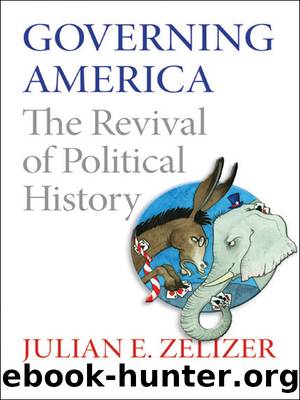
Governing America by Julian Zelizer
Author:Julian Zelizer [Zelizer, Julian]
Language: eng
Format: epub
Tags: History, United States, General, Political Science, Political Ideologies, American Government, Americas (North; Central; South; West Indies)
ISBN: 9781400841899
Google: lNZELCRPj0oC
Publisher: Princeton University Press
Published: 2012-03-04T01:13:37+00:00
1969-1963: Reform without Scandal
The political support emerged between 1969 and 1973. Congress passed legislation in 1971 that improved disclosure and limited costs. Just as important, the reform coalition actively monitored the laws after Congress failed to create any independent enforcement mechanisms. The coalition's reports resulted in unprecedented publicity about money in politics, thereby increasing the political incentives for reform. Much of the information released during this period became central to the Watergate investigations. Without the legislation or the reform coalition, the Watergate scandal of 1974 might not have been nearly as severe.
By 1970, before Watergate, citizens were becoming distrustful of political institutions as a result of Vietnam. Political scientist Gary Orren has shown that public trust in the American government began to decline in 1964 and continued to deteriorate ever since then.51 This political culture made institutional reform seem appealing.
The debate over reform in 1969 began around issues of cost rather than scandal. In 1970, policymakers voiced concerns about increased election costs. A prominent task force study sponsored by the Twentieth Century Fund found that incumbents enjoyed a significant advantage since challengers could not raise the funds needed to manage a successful campaign.52 Democrats were particularly aware of this cost pressure since the party faced a large deficit. Following their widely publicized study on television costs, the National Committee for an Effective Congress (a political action committee composed of liberals) drafted legislation to enable congressional candidates to purchase airtime at a reduced rate. They also proposed ending the equal-time provision of the Communications Act of 1934. The provision discouraged presidential debates by requiring networks to provide every candidate with an opportunity to participate. Although Congress suspended the requirement in 1960, no debates were held in the election of 1968 and the issue subsided. Network executives supported a suspension.53 The proposal reemerged in 1969 as part of the general effort to broaden candidate access to television.
Congress took up legislation in 1969 and 1970, beginning with a bill that included free spots for candidates and additional time at reduced rates. Senators Philip Hart (D-MI), James Pearson (R-KS), and Representative Torbert MacDonald (D-MA) introduced a bill based on the recommendations of the National Committee for an Effective Congress.54 In response, network executives promised to discount rates voluntarily while adamantly opposing free airtime. The Commerce Committee reported a bill that suspended the equal-time provision and limited the rates broadcasters could charge candidates. On April 14, the Senate passed the legislation 58-27 with eight Republicans in favor. Democrats were very aware of how this legislation could change their electoral fortunes. One representative wrote the Speaker that the failure of reform would âhand a big advantage to well financed Republican candidatesâ in his state and similar harm to Democrats in âmarginal districts.â55 The House bill also guaranteed reduced advertising rates and stronger disclosure regulations.
The conference committee eliminated the most controversial provision: an independent commission. Most Democrats opposed the creation of a commission since it would increase enforcement of the laws. Republicans feared that without a commission Democrats would use information for partisan purposes.
Download
This site does not store any files on its server. We only index and link to content provided by other sites. Please contact the content providers to delete copyright contents if any and email us, we'll remove relevant links or contents immediately.
| Anthropology | Archaeology |
| Philosophy | Politics & Government |
| Social Sciences | Sociology |
| Women's Studies |
The Secret History by Donna Tartt(19088)
The Social Justice Warrior Handbook by Lisa De Pasquale(12190)
Thirteen Reasons Why by Jay Asher(8909)
This Is How You Lose Her by Junot Diaz(6886)
Weapons of Math Destruction by Cathy O'Neil(6279)
Zero to One by Peter Thiel(5802)
Beartown by Fredrik Backman(5754)
The Myth of the Strong Leader by Archie Brown(5507)
The Fire Next Time by James Baldwin(5444)
How Democracies Die by Steven Levitsky & Daniel Ziblatt(5218)
Promise Me, Dad by Joe Biden(5153)
Stone's Rules by Roger Stone(5087)
A Higher Loyalty: Truth, Lies, and Leadership by James Comey(4963)
100 Deadly Skills by Clint Emerson(4925)
Rise and Kill First by Ronen Bergman(4788)
Secrecy World by Jake Bernstein(4753)
The David Icke Guide to the Global Conspiracy (and how to end it) by David Icke(4718)
The Farm by Tom Rob Smith(4509)
The Doomsday Machine by Daniel Ellsberg(4490)
